

"My Best Friend"
We're failing people when we treat nicotine addiction and not the whole person

While helping people stop smoking, the thing that pulls at my heartstrings the most is listening to them describe what smoking means to them. I can offer them many ways to use nicotine and ways to quit nicotine entirely. Sometimes, that isn’t enough, and they return to smoking or don’t manage to quit even for a brief period of time.
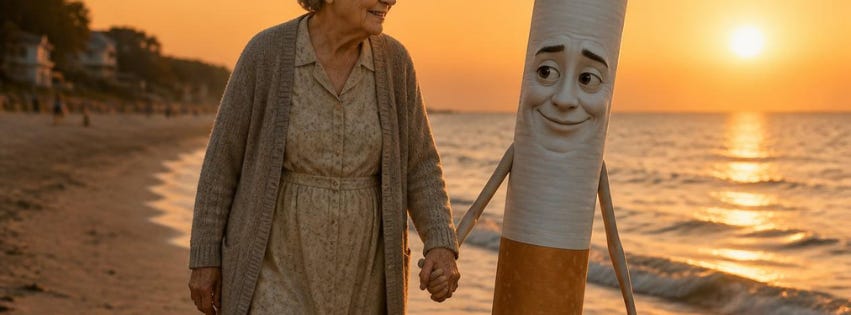
It might be shocking to someone who has never had a relationship with cigarettes to think of smoking literally as a relationship. To hear people describe cigarettes as their friend, their companion. The thing that is with them in good times and bad. Their cigarettes are always there for them when they're lonely, happy, or sad.
Imagine having something so lethal, and knowing it’s lethal, and still holding on to it because it feels like it’s your best friend. As a society, we focus heavily on the addiction to nicotine and ignore what is missing from the person’s life that makes a cigarette a desirable companion.
I had hoped that hearing people describe smoking to me in this way was a rare phenomenon, but a simple online search showed me this isn’t rare at all. Examples of people who describe smoking in this way and studies documenting the same experience across different populations and cultures have now been compiled on a new page on the Safer Nicotine Wiki. Please check out the new page: Nicotine - Smoking Can Be More Than An Addiction.
“The plural of anecdote is data”
Raymond Wolfinger
In my work to help people stop smoking, especially older people who may be more isolated and lonely than my younger clients, I have discovered that I must provide more options than prescription medications, over-the-counter nicotine replacement therapy (NRT), or alternative nicotine products like vapes and pouches. I need to help them discover rewarding things to fill a void in their lives — to help them find a new “friend.”
Those voids have been filled by everything from getting a dog to volunteering at a senior citizen center to joining a book club. Some of my clients don’t even know their neighbors, and doing things like organizing a block party or apartment complex potluck has instantly added new relationships to their lives. Some of my clients have taken up painting, crocheting winter hats for the unhoused, making quilts to donate to the women’s shelter, helping single parents with household repairs, and volunteering at the food shelf.
Treating the addiction and not the whole person is failing the people we hope to help. Listen to their stories and help them make a new “best friend,” one that won’t kill them.
Until next time…
Notes:
I create these newsletters as a personal project. They are not affiliated with any current or past employers or groups with which I volunteer. I receive no financial compensation for my efforts to create these newsletters. I use AI to help with spelling, punctuation, grammar, and editing some of my work.