

Mission Creep
The new "end game?"

It started with a war on “tobacco,” meaning smoking and harmful forms of oral tobacco, and then…
…the focus shifted to vaping, but not as a means to help adults stop smoking. It became all about the youth initiation of nicotine. Even though there’s no tobacco in vapes (and other products), they are all being called “tobacco.” Some people want to see the use of all of these products come to an end. It is the new “end game.” It sickeningly feels like the War on Drugs 2.0.
While conducting a deep dive project on World Vape Day (WVD) vs. World No Tobacco Day (WNTD) (more on that project coming soon, as I dove deeper than I expected), I came across this commentary from 2020: “World No Tobacco Day: what’s in it for us?”
Here are a few lines from that paper: “One could easily ask: How is this of interest to the reader of American Journal of Physiology? First, it should be of interest to anyone working in health research; 8 million people die from tobacco use and tobacco exposure every year, and smoking is a major contributor to social inequality in health...However, this year there is a clear message in the WHO theme. It is about “youth” and it is not restricted to tobacco but includes ‘ ‘nicotine use’.”
Even though my rabbit hole about WVD vs WNTD is already deeper than I am tall, being curious about the changes in messaging over the years from smoking to nicotine made me dig a new rabbit hole.
While researching World No Tobacco Day, I discovered a few things that surprised me. Except for the first WNTD, they have always had the word “tobacco” in them. I would have expected it to have been “smoking” for many years, and then changed. I sometimes forget that in other parts of the world, like several LMICs, there are harmful tobacco products that are not smoked, and that makes using “tobacco” make sense.
I also assumed (you know what they say about assuming!) that the WHO would have been the first organization to promote an awareness day about the harms of smoking. I was wrong. The American Cancer Society (ACS) has the WHO beat by a decade. Here are the significant dates behind The Great American Smokeout from ACS’s website:
“The idea for the Great American Smokeout grew from a 1970 event in Randolph, Massachusetts, at which Arthur P. Mullaney asked people to give up cigarettes for a day and donate the money they would have spent on cigarettes to a high school scholarship fund.”
“Then in 1974, Lynn R. Smith, editor of the Monticello Times in Minnesota, spearheaded the state’s first D-Day, or Don’t Smoke Day.”
“On November 18, 1976, the California Division of the American Cancer Society got nearly 1 million people who smoke to quit for the day. That California event marked the first official Smokeout, and the American Cancer Society took it nationwide in 1977.”
The UK started observing “No Smoke Day” in 1984. Three years later, in 1987, the WHO decided that April 7, 1988, would be “World No Smoke Day.” In 1989, the name was changed to “World No Tobacco Day,” and the date was changed to May 31.
The timeline below lists WHO’s themes for WNTD. I want to see how and when the WHO went from ending death and disease from harmful forms of tobacco to nicotine abstinence, and when their focus switched to youth use of vapor products. I’m hoping following the themes will provide clues to that timing.
We must remember that the market has undergone significant changes since 1988. There are many products on the market now that weren’t available back then. That could contribute to the shift in focus, along with other influential events.
1988 - Tobacco or Health: Choose Health. Encouraged everyone who smoked or chewed tobacco to quit for at least 24 hours.
1989 - Women and Tobacco--The Female Smoker: At Added Risk. “Hiroshi Nakajima, MD, PhD, director-general of the World Health Organization, says the theme reflects concern over "the rapidly increasing use of tobacco among women in most developed and developing countries, with specific consequences for their own and their children's health.”
1990 - Childhood and Youth Without Tobacco. “Emphasized the protection of children and young persons from the adverse health effects of tobacco use.” “WHO estimates that each year, approximately 2.5 million premature deaths occur worldwide as a result of tobacco use.”
1991 - Public Places and Transport: Better Be Tobacco-Free. “Emphasizes the right of all persons to breathe smoke-free air.”
1992 - Tobacco-Free Workplaces: Safer and Healthier. “Emphasize the right to work in a smoke-free environment and the need to coordinate appropriate actions by governments, employees, and employers.” They are still encouraging people to try to quit for at least 24 hours.
1993 - Health Services: Our Window to a Tobacco-Free World. The focus shifted to the importance of healthcare workers and the need for them to serve as good role models.
1994 - The Media and Tobacco: Getting the Health Message Across was an attempt to foster collaboration between the media and public health.
1995 - Tobacco Costs More Than You Think tried to raise awareness of “tobacco-attributable morbidity, mortality, and economic costs.” “Each year, tobacco use accounts for at least 3 million deaths worldwide. Based on current smoking trends, in 30-40 years, tobacco use is projected to cause 10 million deaths annually, of which 70% will occur among persons in developing countries.”
1996 - Sports and the Arts Without Tobacco. The World Health Organization (WHO), in collaboration with the United Nations Educational, Scientific, and Cultural Organization and the International Olympic Committee, co-sponsored WNTD in 1996. “…extends the growing awareness among arts institutions and sports and other event organizers that their events and activities should not be linked to products that impair health and cause premature death.”
1997 - United for a Tobacco-Free World. “World No-Tobacco Day is an annual international event that encourages governments, communities, and other groups to become more aware of the hazards of tobacco use and requests all persons who use tobacco to quit for at least 24 hours.”
1998 - Growing up Without Tobacco. “In many countries, tobacco use is increasing among young persons, and the age of smoking initiation is declining. Most smokers begin smoking during their teenage years.” The WHO encourages the world “to focus on the increasing epidemic of tobacco-related morbidity and mortality, to take strong actions to prevent nicotine addiction in young persons, to protect nonsmokers from the dangers of environmental tobacco smoke, and to provide effective youth-oriented smoking-cessation programs.”
1999 - Leave the Pack Behind. “Preventing tobacco use by young persons is critical for long-term reductions in tobacco-related deaths. However, the projected increase in global mortality from tobacco use, from 3 million deaths in 1990 to 10 million in 2025, primarily represents mortality among persons who already smoke. Smoking cessation interventions can prevent many of these projected deaths.”
2000 - Entertainment and Tobacco Promotion---Countering the Deception. “Intends to raise awareness of the tobacco industry's global marketing practices and to mobilize action to counter the industry's recruitment of new customers through glamorizing tobacco use in films, music, art, and sports.” The WHO launched the "Tobacco Kills---Don't Be Duped" media initiative.
2001 - Second-Hand Smoke Kills---Let's Clear the Air. “Designated by the World Health Organization (WHO) to raise awareness of the hazards of exposure to second-hand smoke.”
2002 - Tobacco-Free Sports---Play It Clean. “Because sports have a universal appeal, WHO and CDC are collaborating to encourage tobacco-free policies and health promotion activities at sporting events worldwide.”
2003 - Tobacco-Free Film and Fashion. Continued the focus on the things that normalize smoking and the ways tobacco is marketed.
2004 - Up in Smoke: Tobacco's Cost to the Family. Raising awareness that tobacco use was responsible for nearly one in 10 adult deaths worldwide and five million deaths each year.
2005 - The role of health professionals in tobacco control. That year, health care providers were encouraged to talk to their patients about smoking. Providers were also encouraged to support tobacco control policies. (It has now been several years since the CDC MMWR about WNTD mentioned quitting smoking for at least 24 hours for WNTD.)
2006 - Tobacco: Deadly in Any Form or Disguise. The goal was to raise awareness about the harmful health effects of all forms of tobacco (e.g., cigarettes [including light, low-tar, and mild], smokeless tobacco, bidis, kreteks, clove cigarettes, cigars, shisha [flavored tobacco smoked in a hookah pipe], and others).”
2007 - Smoke-free environments. Highlighting the hazards of secondhand smoke and the rights of people who don’t smoke, who shouldn’t be forced to breathe secondhand smoke.
2008 - Tobacco-Free Youth: Break the Tobacco Marketing Net. Advocated for a total ban on tobacco advertising, promotion and sponsorship to protect youth from being influenced by the industry to initiate tobacco use.
2009 - Tobacco Health Warnings with an emphasis on the picture warnings that have been shown to be particularly effective at making people aware of the health risks of tobacco use and convincing them to quit. The WHO attributed approximately 5.4 million deaths per year to tobacco use.
2010 - Gender and tobacco, with an emphasis on marketing to women. “Although women account for only about 20% of the world's 1 billion smokers, female smoking rates are on the rise, and tobacco advertising increasingly targets girls and women.”
2011 - The WHO Framework Convention on Tobacco Control (FCTC). This choice aimed to highlight the treaty's importance, emphasize the obligations of participating nations, and promote the roles of the Conference of the Parties and WHO in supporting national efforts.
2012 - Tobacco industry interference. The day “will educate policy-makers and the general public about the tobacco industry's nefarious and harmful tactics.” (Note the death number is rising. “The global tobacco epidemic kills nearly 6 million people each year, of which more than 600,000 are people exposed to second-hand smoke. Unless we act, it will kill up to 8 million people by 2030, of which more than 80% will live in low- and middle-income countries.”)
2013 - Ban tobacco advertising, promotion and sponsorship. A comprehensive ban of all tobacco advertising, promotion and sponsorship is required under the WHO Framework Convention for Tobacco Control (WHO FCTC) for all Parties to this treaty within five years of the entry into force of the Convention for that Party.
2014 - Raise taxes on tobacco. Raising tobacco taxes is a win-win for governments. “Tobacco taxes helps governments by generating revenue and discouraging smoking, which boosts public health and reduces health care costs.”
2015 - Stop illicit trade of tobacco products. From many angles, the illicit trade of tobacco products is a major global concern, including health, legal and economic, governance and corruption.
2016 - Get ready for Plain Packaging. “Plain packaging is an important demand reduction measure that reduces the attractiveness of tobacco products, restricts use of tobacco packaging as a form of tobacco advertising and promotion, limits misleading packaging and labelling, and increases the effectiveness of health warnings.”
2017 - Tobacco: a threat to development. “To support this theme, WHO is calling for activities that include international collaboration highlighting the links between the use of tobacco products, tobacco control, and sustainable development.”
2018 - Tobacco and heart disease. “The campaign will increase awareness on the link between tobacco and heart and other cardiovascular diseases (CVD), including stroke, which combined are the world’s leading causes of death.” (Note: Another increase in global annual deaths. “The global tobacco epidemic kills more than 7 million people each year, of which close to 900,000 are non-smokers dying from breathing second-hand smoke.”)
2019 - Tobacco and lung health. The campaign will increase awareness on: the negative impact that tobacco has on people’s lung health, from cancer to chronic respiratory disease, and the fundamental role lungs play for the health and well-being of all people.
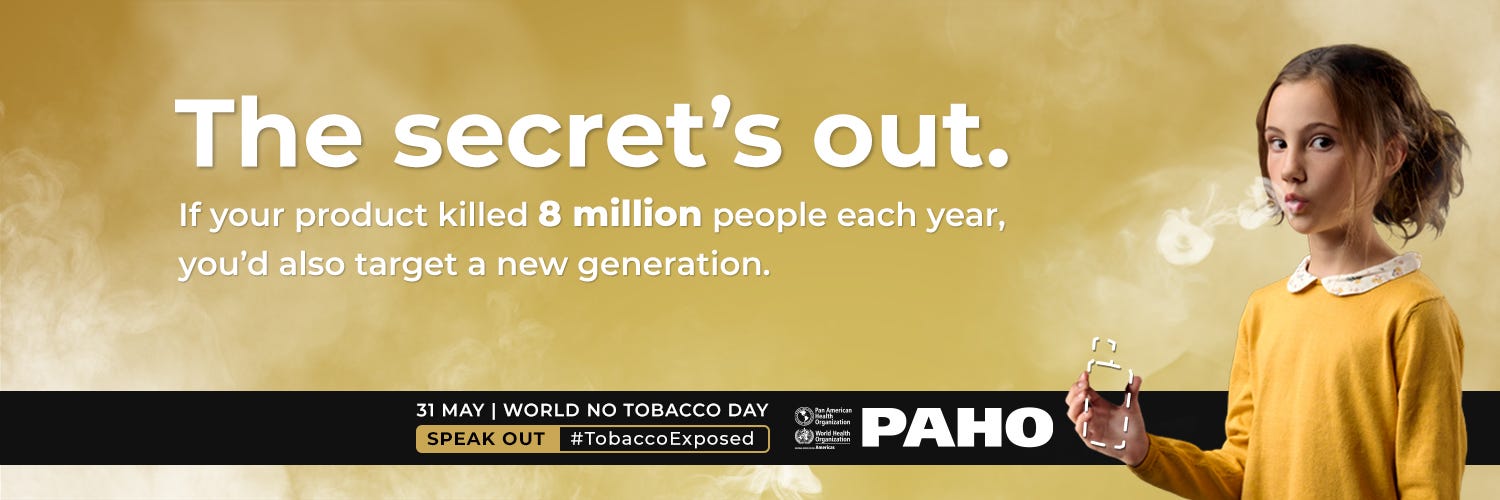
2020 - #TobaccoExposed. “The global campaign will debunk myths and expose devious tactics employed by these industries. It will provide young people with the knowledge required to easily detect industry manipulation and equip them with the tools to rebuff such tactics, thereby empowering young people to stand up against them. This is especially important right now as studies show that smokers have a higher risk for a severe case of coronavirus. WHO calls on all young people to join the fight to become a tobacco-free generation…Flavours appealing to children in smokeless tobacco, shisha and e-cigarettes.”
2021 - Commit to quit. “The scientific evidence on e-cigarettes as cessation aids is inconclusive and there is a lack of clarity as to whether these products have any role to play in smoking cessation. Switching from conventional tobacco products to e-cigarettes is not quitting.”
2022 - Poisoning Our Planet: #TobaccoExposed. “Tobacco kills over 8 million people every year and destroys our environment, further harming human health, through the cultivation, production, distribution, consumption, and post-consumer waste.”
2023 - Grow food, not tobacco. “Tobacco growing harms our health, the health of farmers and the planet’s health. The tobacco industry interferes with attempts to substitute tobacco growing, contributing to the global food crisis.”
2024 - Protecting children from tobacco industry interference. “World No Tobacco Day 2024 will give a platform to young people across the world, who are urging governments to shield them from predatory tobacco marketing tactics. The industry targets youth for a lifetime of profits, creating a new wave of addiction. Children are using e-cigarettes at rates higher than adults in all regions and globally an estimated 37 million youth aged 13–15 years use tobacco.”
2025 - Bright Products. Dark Intentions. Unmasking the Appeal. “Appealing flavours, but hidden dangers. Shameless manipulation of our children, for industry profit.”
Until next time…

Notes:
I create these newsletters as a personal project. They are not affiliated with any current or past employers or groups with which I volunteer. I receive no financial compensation for my efforts to create these newsletters.
My blog, Skip's Corner, has an X/Twitter account. My personal accounts are on BlueSky, LinkedIn, and X (Twitter).
Very interesting, Skip. The first World No Tobacco Day was celebrated on April 7, 1988 (which coincided with World Health Day), but since then, it has been moved to May 31. In other words, it has symbolically and effectively separated itself from World Health Day.